




























0
Views
0
Downloads

0.0
0
Save
0 Likes
Share
Hund's Rule and Orbital Filling Diagrams
0 Views
0 Downloads

Paste this activity's link or code into your existing LMS (Google Classroom, Canvas, Teams, Schoology, Moodle, etc.).
Students can open and work on the activity right away, with no student login required.
You'll still be able to track student progress and results from your teacher account.
Information
Description
What It Is:
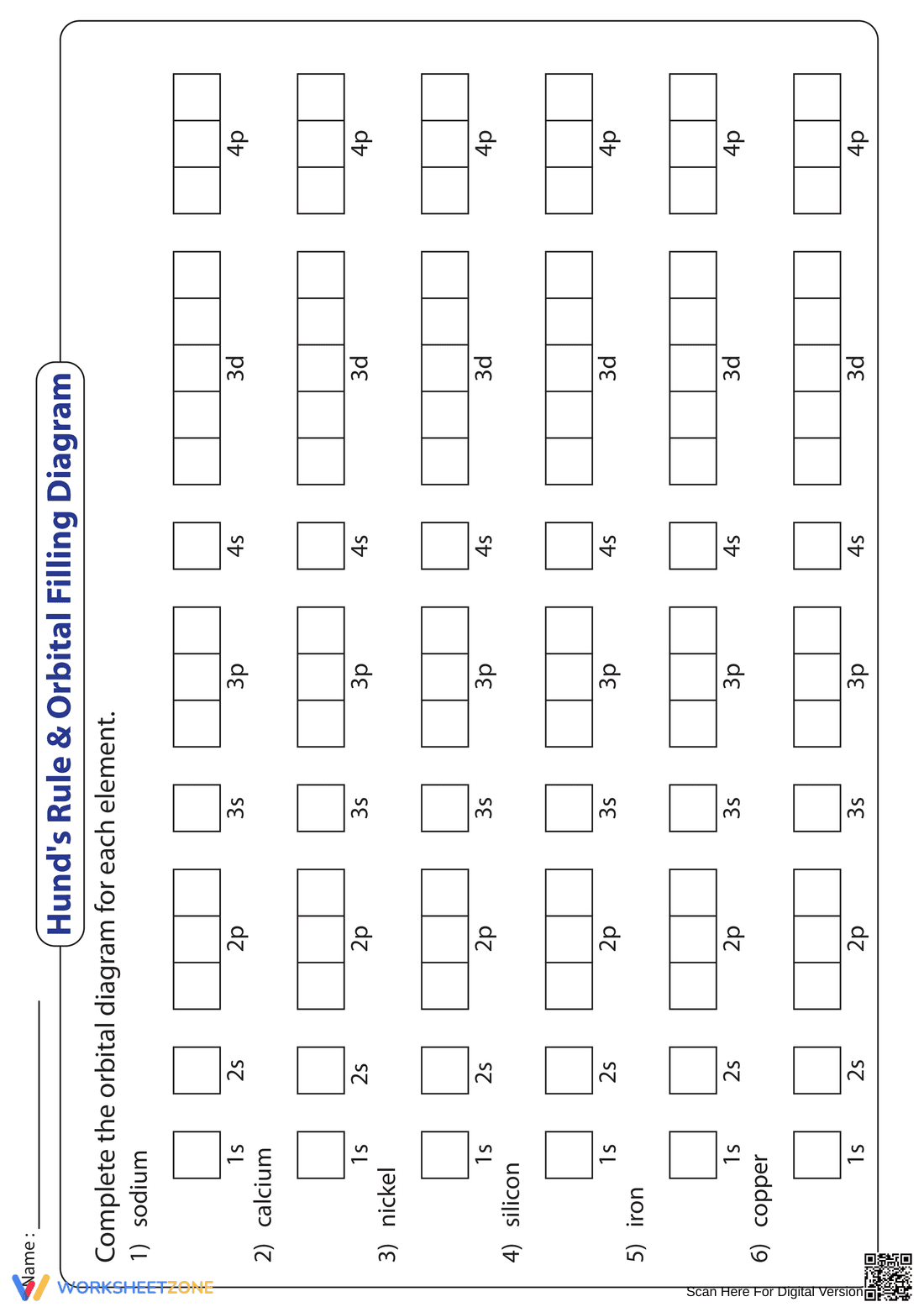
This is a chemistry worksheet focused on Hund's Rule and orbital filling diagrams. It presents a table where students can fill in the electron configuration for different elements: sodium, calcium, nickel, silicon, iron, and copper. The worksheet provides boxes to represent the 1s, 2s, 2p, 3s, 3p, 4s, 3d, and 4p orbitals, allowing students to visually represent the electron filling process according to Hund's rule.
Grade Level Suitability:
This worksheet is suitable for grades 9-12, specifically for high school chemistry students. It requires an understanding of atomic structure, electron configuration, and Hund's rule, which are typically covered in high school chemistry courses.
Why Use It:
This worksheet helps students visualize and understand the concept of electron configuration and Hund's rule. It provides a hands-on activity that reinforces the rules for filling orbitals, promoting a deeper understanding of atomic structure and chemical properties. It also helps develop problem-solving skills in chemistry.
How to Use It:
Students should first determine the number of electrons for each element. Then, they fill in the boxes representing each orbital (1s, 2s, 2p, etc.) with arrows to represent electrons, following Hund's rule (maximizing spin before pairing electrons within a subshell). The boxes are designed to visually represent the number of orbitals within each subshell (e.g., three boxes for the 2p subshell).
Target Users:
The target users are high school chemistry students learning about electron configuration and Hund's rule. It is also useful for chemistry teachers looking for worksheets to reinforce these concepts in their classroom.
This is a chemistry worksheet focused on Hund's Rule and orbital filling diagrams. It presents a table where students can fill in the electron configuration for different elements: sodium, calcium, nickel, silicon, iron, and copper. The worksheet provides boxes to represent the 1s, 2s, 2p, 3s, 3p, 4s, 3d, and 4p orbitals, allowing students to visually represent the electron filling process according to Hund's rule.
Grade Level Suitability:
This worksheet is suitable for grades 9-12, specifically for high school chemistry students. It requires an understanding of atomic structure, electron configuration, and Hund's rule, which are typically covered in high school chemistry courses.
Why Use It:
This worksheet helps students visualize and understand the concept of electron configuration and Hund's rule. It provides a hands-on activity that reinforces the rules for filling orbitals, promoting a deeper understanding of atomic structure and chemical properties. It also helps develop problem-solving skills in chemistry.
How to Use It:
Students should first determine the number of electrons for each element. Then, they fill in the boxes representing each orbital (1s, 2s, 2p, etc.) with arrows to represent electrons, following Hund's rule (maximizing spin before pairing electrons within a subshell). The boxes are designed to visually represent the number of orbitals within each subshell (e.g., three boxes for the 2p subshell).
Target Users:
The target users are high school chemistry students learning about electron configuration and Hund's rule. It is also useful for chemistry teachers looking for worksheets to reinforce these concepts in their classroom.


